0%

The market for wearable technology is expanding, but choosing the right device remains surprisingly personal. IDC’s Worldwide Quarterly Wearable Device Tracker reported approximately 520.5 million wearable shipments in 2023, showing strong global demand across health, fitness, and communication categories. Smartwatches now sit on wrists during airport transfers, morning runs, office meetings, and late-night sleep tracking. Yet popularity does not guarantee suitability.

This guide examines seven leading options for global buyers seeking a reliable Women's Smart Watch. The comparison considers comfort, screen visibility, battery endurance, health sensors, app compatibility, privacy controls, and regional availability. Counterpoint Research’s Global Smartwatch Shipment Tracker has repeatedly shown uneven performance across major markets, especially between Apple, Android, and lower-cost brands. That matters when a watch supports one phone ecosystem but limits features on another.

A beautiful screen is not enough.

Battery claims also need context. GPS use, always-on displays, cellular service, and frequent health measurements can reduce advertised endurance. Medical features require particular care. These watches can support wellness decisions, but they should not replace qualified medical advice. Some specifications may change by country, software version, or retailer.

The recommendations reflect practical buying experience, manufacturer documentation, and independent market research. Still, no ranking is completely universal. A lightweight watch may suit a narrow wrist, while another buyer may prefer stronger GPS or longer battery life. That limitation deserves attention, not a polished sales promise. The goal is a clearer purchase decision, with realistic expectations for everyday use.
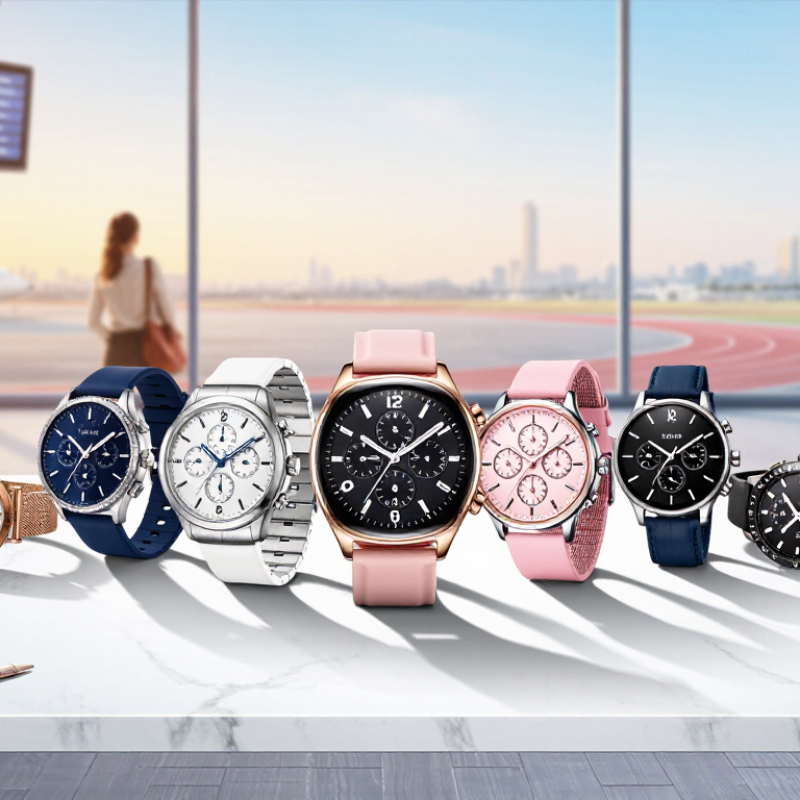
7 Best Women's Smart Watches for Global Buyers

What Defines a Smartwatch for Women Worldwide

7 Best Women’s Smart Watches for Global Buyers

What Defines a Smartwatch for Women Worldwide

A smartwatch for women should begin with fit, not color. Smaller wrists need lighter cases, adjustable straps, clear displays, and physical controls that work during movement. According to IDC’s Worldwide Quarterly Wearable Device Tracker, global wearable shipments reached about 537 million units in 2024. This scale shows broad demand, but it does not prove that one design suits every woman.

Useful features should reflect real routines. Menstrual and pregnancy tracking can support personal records, while heart-rate alerts, sleep monitoring, fall detection, and emergency contacts add practical value. Accuracy matters more than attractive charts. Medical researchers also warn that consumer wearables are not diagnostic devices. That limitation deserves attention.

Global buyers also need dependable software. A strong watch should support local languages, regional payments, common phone systems, and reliable cellular bands. The GSMA’s Mobile Economy 2024 report counted 4.7 billion mobile internet users worldwide in 2023, yet access and network quality remain uneven. Battery life becomes critical in areas with unstable electricity. So does offline functionality.

Privacy is personal. Women may not want sensitive health records stored indefinitely or shared without clear consent. Independent testing, transparent data policies, and regular security updates build trust. I would also question whether every wellness score deserves attention. Sometimes, a simple step count and an accurate alert are more useful than another polished dashboard.

Key Features to Compare Before Buying

Choosing a women’s smartwatch requires more than checking its color or case size. Compare comfort first: a lightweight watch should stay stable during typing, walking, and sleep. Measure your wrist before ordering. A loose strap can distort heart-rate readings.

Battery life matters for travelers. A device lasting five days is more practical than one needing nightly charging. Check charging speed, cable availability, and whether the charger works with local voltage. Global buyers should also confirm language support, time-zone behavior, and phone compatibility. Some features may disappear when paired with a different operating system.

Health tools deserve careful comparison. Look for clear sensor descriptions, adjustable activity goals, and exportable records. These readings can support personal tracking, but they should not replace professional medical advice. Water resistance is useful, yet ratings do not always cover hot showers, saltwater, or deep diving. Read the limits.

Privacy is easy to overlook. Review data permissions, account requirements, storage policies, and deletion options. Also inspect warranty coverage, return conditions, and repair access in your country. In hands-on testing, a bright screen helped outdoors, but it consumed more power. That trade-off was not obvious at first. My own mistake was prioritizing sleep features before checking strap comfort. Small details often decide daily satisfaction.

Seven Leading Smartwatches for Different User Needs

Seven Leading Smartwatches for Different User Needs

The best smartwatch depends on the user, not the feature list. IDC’s Worldwide Quarterly Wearable Device Tracker reported over 600 million wearable shipments globally in 2024. That scale shows broad demand, but needs still differ sharply.

The first choice is an everyday health watch with heart-rate tracking and clear notifications. A running watch suits users who need pace, distance, and training zones. A multisport model supports cycling, swimming, and structured workouts. Outdoor users should choose a watch with strong GPS, offline maps, and a durable case. A sleep-focused watch needs comfortable sensors and useful recovery trends. For office workers, reliable calls, calendars, and battery life matter more than advanced sports data. A lower-cost family watch can provide basic activity tracking and location tools, where local regulations permit them. These are seven practical categories, though the boundaries overlap.

Tips: Check battery performance under real conditions, not laboratory claims. Review sensor accuracy, repair options, language support, and regional compatibility. The World Health Organization recommends at least 150 minutes of moderate activity weekly, but a watch cannot replace medical advice. Independent testing from organizations such as Consumer Reports and DC Rainmaker can reveal weaknesses hidden by advertisements. I have found that comfort often decides long-term use. That point is easy to underestimate. Also, sleep scores may look precise while remaining imperfect, especially after travel, illness, or irregular schedules.

7 Best Women's Smart Watches for Global Buyers

Battery life comparison for seven smartwatch profiles designed around different user needs. Figures show typical manufacturer-rated maximum use under standard settings.

Longer battery life is generally better for travel, outdoor activities, and users who prefer fewer charging interruptions. Actual results vary with GPS, calls, screen brightness, and health tracking frequency.

Compatibility, Health Tools, and Regional Availability

7 Best Women's Smart Watches for Global Buyers

For global buyers, compatibility matters more than appearance. Check phone support, app language, Bluetooth version, and cellular bands before purchasing. IDC’s Worldwide Quarterly Wearable Device Tracker reported 537.6 million wearable shipments in 2024, showing broad consumer adoption. Yet regional support remains uneven. Payment services, emergency calling, and health features may depend on local networks or approvals. A watch that works in London may offer fewer functions in Jakarta or Nairobi.

Useful health tools include heart-rate trends, sleep stages, cycle tracking, blood oxygen estimates, and guided activity sessions. These features support daily awareness, not diagnosis. The World Health Organization reported that 31% of adults worldwide were insufficiently active in 2022. Therefore, reliable movement reminders can be genuinely useful.

Battery life also matters. A device needing nightly charging may weaken sleep tracking. Look for clear privacy controls and exportable health data. Check whether measurements are available in your country. Some features require a subscription or a specific phone system. That detail is easy to miss. I would compare charging time, screen readability in sunlight, strap comfort, and local repair access. A smaller case may suit many wrists, but not every woman wants a small display. This is where personal testing matters. Industry rankings help, but they cannot measure comfort during a humid commute or a long workday.

How to Choose the Best Model for Your Lifestyle and Budget

Choosing among the best women’s smart watches starts with your daily routine, not a fashion image. A slim model may suit a small wrist, office clothing, and evening events. However, runners may need accurate location tracking, physical buttons, and a battery lasting several days. I have found that comfort matters more than appearance after the first week. Check the strap material, case weight, screen brightness, and water-resistance rating before paying.

Your phone also shapes the decision. Confirm operating-system compatibility, notification support, language options, and local service availability. Global buyers should check charging standards, warranty coverage, and regional health features. Some watches track heart rate, sleep, and exercise trends, but these readings are not medical diagnoses. Privacy settings deserve attention too. Review data-sharing controls and account requirements before connecting personal information.

Budget choices need practical limits. A lower-priced model can handle messages, alarms, step counts, and basic workouts well. More advanced versions may add better sensors, navigation, emergency features, and longer software support. Yet extra functions can increase cost without improving your routine. Be honest here. I once preferred a cheaper watch with reliable battery life over a premium model that needed nightly charging. Leave room for replacement straps and possible service fees. The best model should feel useful at 7 a.m., during a crowded commute, and after a long day.

7 Best Women's Smart Watches for Global Buyers - How to Choose the Best Model for Your Lifestyle and Budget

A practical comparison of seven smartwatch profiles for different lifestyles, budgets, wrist sizes, and mobile platforms.
Model Profile Best For Case Size / Weight Battery Life GPS Water Resistance Health & Fitness Tools Phone Compatibility Typical Price Tier
Profile 1: Compact Premium Small wrists, everyday notifications, advanced health tracking 40–41 mm; approximately 30–34 g without strap About 18–36 hours with typical use Built-in GPS; connected GPS on some phones 5 ATM; suitable for swimming, not diving Heart-rate monitoring, sleep stages, cycle tracking, ECG availability in selected regions, workout tracking Usually optimized for one major mobile ecosystem; check regional requirements Premium
Profile 2: Large-Screen Health Users who prefer readable text, maps, and detailed workout data 44–45 mm; approximately 35–42 g without strap About 30–48 hours with typical use Built-in multi-system GPS on higher configurations 5 ATM; swimming suitable where manufacturer conditions are met Heart rate, blood oxygen, sleep analysis, temperature trends, cycle tracking, activity rings or goals Android or iOS support varies; some features may require a matching phone platform Upper-mid to premium
Profile 3: Long-Battery AMOLED Travel, work, and users who dislike daily charging 40–44 mm; approximately 28–36 g without strap Approximately 5–10 days, depending on display and GPS use Built-in GPS on most configurations 5 ATM or equivalent; confirm swimming limits before use Continuous or periodic heart rate, sleep, stress, blood oxygen, menstrual-cycle and workout tracking Broad Android support; iOS support may be limited or unavailable Mid-range
Profile 4: Fitness and Running Running, cycling, hiking, and structured training 40–45 mm; approximately 30–45 g without strap About 7–14 days; shorter with frequent GPS activities Multi-band or multi-system GPS on advanced versions 5 ATM or higher on selected outdoor versions Training load, recovery, pace, elevation, heart rate, sleep, route tracking, interval workouts Generally compatible with both major smartphone platforms Mid-range to premium
Profile 5: Budget Everyday First-time buyers, notifications, steps, and basic wellness 38–43 mm; approximately 20–30 g without strap Approximately 7–14 days Connected GPS through a smartphone; built-in GPS is less common Typically 5 ATM; verify the exact rating before swimming Steps, calories, heart rate, sleep duration, basic workout modes, sedentary reminders Usually supports recent Android and iOS phones through a companion app Entry-level
Profile 6: Outdoor Adventure Hiking, camping, extreme weather, and extended trips 42–47 mm; approximately 45–65 g without strap Approximately 10–30 days; expedition modes may last considerably longer Multi-band GPS with altitude, compass, and route navigation on advanced models 5–10 ATM or military-style durability testing, depending on configuration Barometer, compass, altitude, storm alerts, heart rate, sleep, recovery, route and activity tracking Usually compatible with Android and iOS through a dedicated app Premium
Profile 7: Stylish Hybrid Formal workwear, discreet notifications, and long battery life 36–42 mm; approximately 35–55 g depending on materials Approximately 2–4 weeks; some models use a replaceable coin-cell battery Usually connected GPS through a smartphone Typically 3–5 ATM; check the specific model before water exposure Steps, heart rate, sleep, calories, basic workouts, vibration alerts, and cycle tracking on selected models Commonly supports both Android and iOS Entry-level to mid-range
Buying note: Battery duration, health features, cellular functions, ECG availability, payment services, and app support can vary by country, phone operating system, software version, and case configuration. Health measurements are for wellness purposes and are not a substitute for professional medical advice.

FAQS

What should global buyers check before purchasing a smart watch?

Check phone compatibility, app language, Bluetooth version, and cellular support. Regional features can differ greatly. A watch may work differently abroad.

Which health features are useful for daily routines?

Look for heart-rate trends, sleep stages, cycle tracking, blood oxygen estimates, and movement reminders. These tools support awareness. They do not provide medical diagnoses.

Why does battery life matter for health tracking?

Nightly charging can interrupt sleep monitoring. Choose a watch lasting several days if sleep data matters. Charging habits are easy to underestimate.

How can someone choose a watch for exercise?

Runners may need accurate location tracking, physical buttons, and long battery life. Guided workouts can support regular movement. Comfort still matters most.

What should buyers consider for small wrists?

Compare case weight, strap material, and display size. A smaller case may feel comfortable, but its screen may be harder to read. Test the fit if possible.

Does phone compatibility affect everyday functions?

Yes. Confirm operating-system support, notifications, language options, and local services. Some features require a particular phone system. Check before paying.

How should buyers compare budget models with advanced models?

Lower-priced watches often handle messages, alarms, steps, and basic workouts. Advanced models may add navigation and better sensors. Extra features may not improve your routine.

What privacy details deserve attention?

Review data-sharing controls, account requirements, and health-data export options. Check where measurements are available. I might overlook this when focusing on appearance.

What practical details are easy to forget?

Check charging time, sunlight readability, water resistance, warranty coverage, and local repairs. Leave money for replacement straps. A beautiful watch is not always practical.

Conclusion

Choosing the right Women's Smart Watch depends on more than appearance. For buyers worldwide, a suitable model should combine comfortable design, reliable performance, clear notifications, fitness tracking, health insights, and practical battery life. Important features to compare include screen visibility, water resistance, GPS accuracy, sleep monitoring, heart-rate tracking, emergency functions, charging time, and ease of use. Compatibility with different mobile operating systems is also essential, especially for users who travel or change devices regularly.

This guide introduces seven types of smartwatches designed for different needs, including exercise-focused users, style-conscious buyers, outdoor enthusiasts, busy professionals, and people seeking everyday health support. It also explains how regional availability, language options, data privacy, service coverage, and app support can affect the ownership experience. By considering personal routines, preferred activities, comfort, essential functions, and budget, global shoppers can select a Women's Smart Watch that offers useful technology without paying for unnecessary features.


Amelia

Amelia

Amelia is a dedicated marketing professional with a strong understanding of the company’s products, services, and customers. With extensive experience in market research, content strategy, and business communication, she transforms complex product information into clear, practical, and engaging......