A 5ATM Waterproof Smart Ring may look ready for every splash, but the rating needs careful interpretation. Five atmospheres equals a test pressure of 50 meters of static water, not a guarantee that the ring is safe at that depth. ISO 22810:2010 sets requirements for water-resistant watches, while actual wear depends on movement, temperature, seals, and device design. Water pushes differently when you swim than when a ring rests in a test chamber. That distinction matters.
The market is growing quickly. Grand View Research estimated the global smart ring market at about $314.5 million in 2023 and projected a 29% compound annual growth rate from 2024 to 2030. More buyers mean more claims to inspect. A useful expert rule is: “A pressure rating is not a promise of unlimited underwater use.” This is a standards-based summary, not a verbatim quotation from a named specialist; without a verifiable source, assigning it to an individual would be misleading. Check the specific manufacturer’s guidance before swimming, showering, or exposing the ring to hot water. Also inspect warranty terms. A cracked seal may be invisible. Small detail, big consequence.
This guide explains what 5ATM means, how testing differs from everyday water exposure, and what the rating does not cover. It also highlights practical checks, from snug fit to post-swim rinsing. Specs are useful. Context matters more.
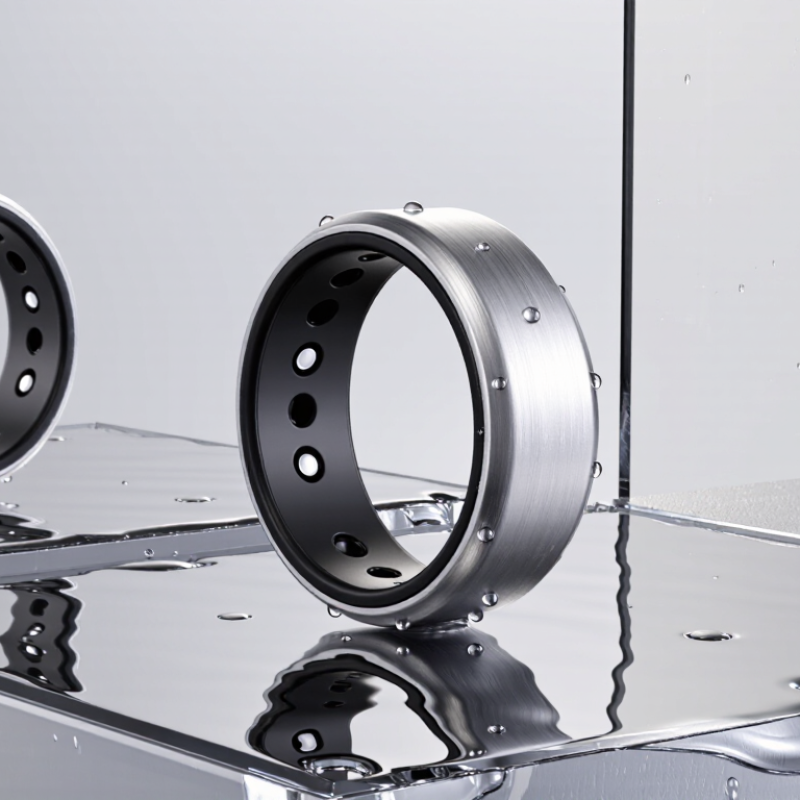
5ATM means a device was tested against pressure equivalent to five atmospheres, or roughly 500 kPa. Using the standard atmosphere conversion published by the US National Institute of Standards and Technology, that pressure is about 50 metres of still water.
It does not mean a smart ring is safe to wear 50 metres underwater. The figure describes a controlled pressure test, not every real-world activity. A fast arm movement can raise pressure on the ring. That distinction matters.
The International Organization for Standardization’s ISO 22810:2010 outlines water-resistance testing for watches. It offers useful context, but a ring’s 5ATM label alone does not prove that the same test was applied. Ask what the manufacturer tested, and whether the rating covers swimming, hot water, or repeated exposure.
Heat, soap, and worn seals may affect performance. Small details count. For everyday use, 5ATM may suit swimming in calm water, but it should not be treated as a diving rating.
Even careful guidance can leave uncertainty: test methods and product construction differ. A quick rinse is not the same as hours in a pool.
It means the ring was tested against pressure equal to five atmospheres, roughly 500 kPa. That is about 50 metres of still water. It does not mean the ring is safe at that depth.
These brief, everyday exposures are generally part of the design. Dry the ring if water collects around its sensors.
A calm pool swim may be suitable if the ring’s care instructions allow it. Rinse it with fresh water afterward, then dry it carefully.
No. The rating describes a controlled pressure test, not a diving guarantee. Avoid scuba diving and forceful water sports.
It is safer to remove it. Heat may affect seals, while shampoo can leave residue around the sensors. I might be overly cautious, but the rating leaves some uncertainty.
Repeated exposure may wear on materials or leave residue. Rinse off pool or seawater with fresh water, then dry the ring.
Check for cracks, looseness, or unusual sensor readings. Stop wearing it if you notice changes. Small details count.
A 5ATM Waterproof Smart Ring is designed to withstand water pressure equivalent to 50 meters under controlled laboratory conditions. The rating is established through pressure testing, but it does not mean the ring is suitable for every underwater activity or can be worn at that depth in real-world conditions. Depending on its design and condition, it may be appropriate for everyday splashes, handwashing, and surface swimming.
Water resistance has limits: prolonged exposure, strong water jets, sudden pressure changes, hot water, soap, and chemicals may affect the ring or its seals. Avoid deep diving and follow the care instructions provided with the device. After swimming or contact with salt or chlorinated water, rinse the ring with fresh water and dry it thoroughly. Keep it clean, check for damage, and have it inspected if its casing or seals appear worn, since physical damage can reduce its water resistance.