Smart rings promise useful insights without the bulk of a watch, but choosing one takes more than comparing glossy product photos. A Ceramic Smart Ring can offer a smooth, understated finish and a comfortable feel for everyday wear. Yet ceramic is not automatically the right choice for every buyer. Fit, durability, sensor performance, and app quality matter just as much.
This 2026 guide compares ten options through practical buying considerations: health and activity features, battery life, sizing support, phone compatibility, and the clarity of each brand’s subscription terms. It also looks at how a ring feels during ordinary routines, from typing at a desk to sleeping overnight. Small details count. A ring that looks elegant may still feel bulky, while a polished app cannot make up for unreliable syncing. Those trade-offs are easy to miss at first.
Specifications do not tell the whole story, and product features can change with software updates. This guide therefore focuses on what buyers can verify and what deserves a closer look, rather than treating marketing claims as proof. Smart rings can help users notice patterns in sleep or activity, but their readings should not replace professional medical advice. No ring is perfect. The best choice depends on your priorities, comfort, and budget. Use the comparisons ahead to find a Ceramic Smart Ring that fits real life, not just a product page.
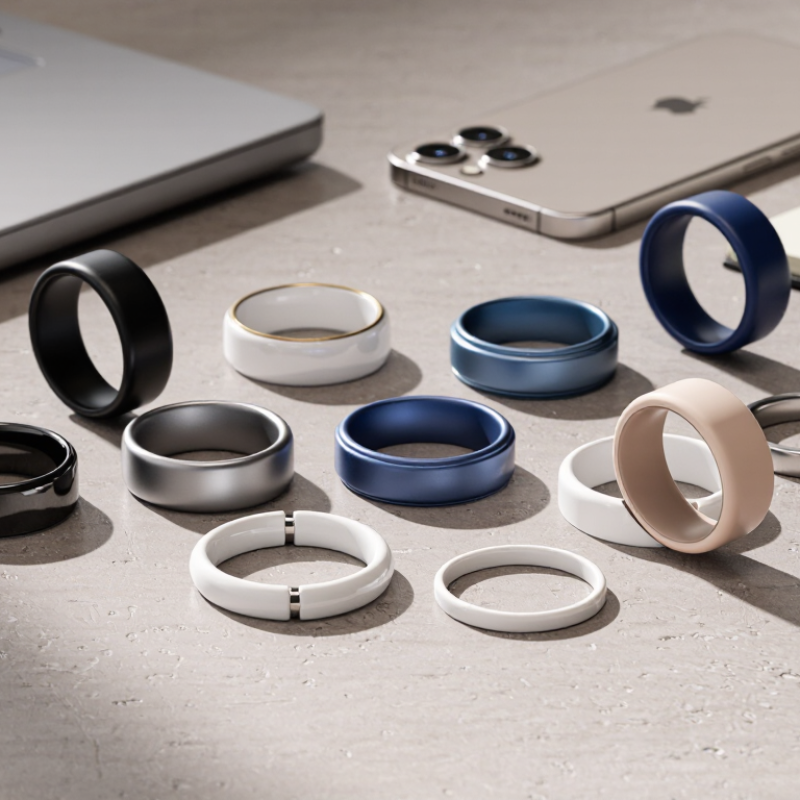
Ceramic Smart Rings: Materials, Design, and Essential Features
Ceramic smart rings often use zirconia, a dense material valued for its smooth finish and resistance to everyday scratches. It feels cool against the skin, though impact can still chip or crack it. Check the ring’s edges and inner surface; rough seams may irritate after hours of wear. Lightweight does not always mean comfortable.
Grand View Research estimated the global smart ring market at $314.9 million in 2023 and projected a 24.1% annual growth rate from 2024 to 2030. That forecast signals interest, not proof that ceramic suits every buyer. Market estimates also vary with what each report counts. Forecasts are not guarantees.
For practical use, prioritize secure sensor contact, clear sleep and activity records, and battery life that fits your routine. Optical sensors need a close fit, but a ring should not pinch when fingers swell overnight. Try sizing in warm conditions, too. Ceramic models may offer fewer repair options if damaged, so ask about replacement policies before buying. A polished surface looks refined; it can also show smudges under bright light. Small trade-off.
| No. | Buyer priority | What to look for | Ceramic and design facts | Practical trade-off |
|---|---|---|---|---|
| 1 | Scratch resistance | Check the exact outer material and whether the maker publishes a scratch-resistance specification. | Zirconia ceramic is commonly rated around 8–8.5 on the Mohs hardness scale, making it resistant to many everyday scratches. | Hardness does not mean impact-proof: ceramic can chip or crack if struck against a hard surface. |
| 2 | Comfort and weight | Compare the ring’s measured weight, width, thickness, and inner-surface shape; try the fit for a full day if possible. | Ceramic rings can feel smooth and substantial, but weight and comfort depend on the ring’s size, construction, and sensor layout. | A wide ring may feel restrictive when fingers swell, even if its nominal size is correct. |
| 3 | Sizing accuracy | Use the maker’s sizing kit or measurement method rather than assuming standard jewelry sizing will match. | Smart-ring sizing can differ from conventional ring sizing because the inner sensors and ring profile affect fit. | Finger circumference changes with temperature and time of day; a ring that is too loose may also collect less reliable sensor readings. |
| 4 | Health sensors | Look for a clear sensor list, such as optical heart-rate sensing, skin-temperature sensing, and motion sensing. | Optical sensors typically use light to estimate pulse-related signals; accelerometers detect movement and activity. | Sensor availability and measurement quality vary by device. Confirm that the specific ceramic model includes the features you need. |
| 5 | Useful health insights | Check which features are measured, which are estimates, and whether reports are available in the companion app. | Some smart rings track sleep, resting heart rate, heart-rate variability, activity, and overnight skin-temperature trends. | Skin-temperature trends are not the same as a clinical core-body-temperature measurement; consumer readings are not a diagnosis. |
| 6 | Battery life | Compare the stated battery life under typical use and check whether continuous measurements shorten it. | Battery life is model-dependent; many smart rings advertise several days per charge, often roughly 3–7 days under specified conditions. | Actual runtime varies with size, settings, sensor use, connectivity, and battery age. Verify the figure for the exact model. |
| 7 | Charging method | Confirm whether the ring includes a charging cradle or case and how long a full charge takes. | Compact rechargeable batteries are generally charged using a model-specific dock, cradle, or case. | Proprietary chargers may be inconvenient to replace or travel with; check whether a spare charger is available. |
| 8 | Water protection | Read the published water-resistance rating and its stated limits for swimming, bathing, and other use. | Water protection is a property of the complete ring, seals, and construction—not of the ceramic material alone. | Ratings and warranty coverage differ. Do not assume that a ceramic exterior makes the electronics suitable for every water activity. |
| 9 | Phone and app compatibility | Check supported phone operating systems, Bluetooth requirements, app availability, and any subscription terms. | Smart rings typically sync with a phone over Bluetooth; the app provides setup, data history, and health summaries. | Compatibility, app features, and access to historical data can change by operating-system version or service plan. |
| 10 | Durability and support | Review the warranty, repair or replacement policy, and guidance for impacts, chemicals, and temperature exposure. | Ceramic surfaces can resist everyday abrasion, but brittle materials may be more vulnerable to sharp impacts than some metals. | Confirm how the maker handles cracks, battery wear, and electronic faults before buying; ceramic damage may not be repairable. |
Buyer note: Smart-ring specifications are model-specific, and ceramic construction alone does not establish sensor capability, battery life, or water resistance. Compare the published specifications and warranty for each product before purchase.
Many use zirconia, a dense ceramic with a smooth finish. It resists everyday scratches, but can chip after a hard impact.
Not always. Check the inner surface and edges for rough seams. A ring should feel snug without pinching when fingers swell.
Optical sensors shine light into the skin to estimate pulse patterns. Motion sensors record movement during the day. These are estimates.
It combines movement, pulse, and sometimes temperature readings to estimate sleep. Those stages are not equivalent to a clinical sleep study.
Loose fit can interrupt sensor contact. Cold fingers may also affect readings. Try the sizing guide, then wear the ring for several nights.
Compare trends with how you feel, not just a score. Persistent health concerns deserve qualified medical advice. A ring is not a diagnosis.
It can resist everyday scratches, yet still crack or chip on a hard floor. Ask about replacement options before buying. Repair choices may be limited.
Battery life should fit your routine, and sensors need steady contact. Polished surfaces may show smudges under bright light. A small but real trade-off.
One estimate valued the global smart ring market at $314.9 million in 2023. Forecasts suggest growth, but they do not prove ceramic suits everyone.
This guide explores what makes a Ceramic Smart Ring different, from its material and polished design to the everyday features buyers may want. It explains how smart rings can use built-in sensors to track health indicators, activity, and sleep, while noting that readings are useful for personal awareness rather than a substitute for professional medical advice. It also outlines the main points to compare in 2026, including comfort, fit, battery life, sensor capabilities, app experience, durability, and overall value.
The guide reviews ten Ceramic Smart Ring options worth considering and offers practical advice for choosing a design that suits your needs. Readers will also learn how to measure for the right size, allow for changes in finger comfort, and care for a ceramic ring to help preserve its appearance. Together, these sections provide a clear starting point for comparing options and choosing a ring for everyday use.